Matt & Ying Coyle
Wellesley Hills Wellesley MA Real Estate & Neighborhood Guide
Village Lifestyle | Wellesley Hills, Wellesley MA
Historic. Connected. Convenient.
Why Live in Wellesley Hills?
If you want a neighborhood that blends a quintessential New England feel with a modern, connected lifestyle, Wellesley Hills is a standout choice.
The area is defined by its walkable village core, centered around the historic Wellesley Hills station and the convenience of Linden Square. While Wellesley Farms offers more secluded estates, the Hills prioritizes everyday ease and community connection. It also offers a broader housing mix and stronger regional access, while feeling less dense than more in-town districts like Wellesley Square and Dana Hall.
For buyers seeking a blend of historic character, commuter convenience, and established residential charm, Wellesley Hills offers one of the town’s most balanced lifestyles.
Balanced Market: Strategy Matters
The Wellesley single-family market remains one of Greater Boston’s most expensive and sought-after destinations in 2026. However, based on April year-to-date data, the market is cooling from last year’s pace:
- New listings are down 10.2%
- Closed sales are down nearly 24%
- The median sale price has declined 4.2% to $1.988M
Collectively, the data suggests that the market has met resistance at current price levels. Demand remains present, but buyers and sellers are now on more equal footing than they were during the peak seller-market years.
This shift is most visible in the sale-to-original-list-price ratio. Year to date, Wellesley homes have sold for a median of 97.84% of their original asking price, down from 99.49% last year. In practical terms, more homes are selling below their original list price — clear evidence that buyers have more leverage than they did a year ago.
For sellers, don’t despair — it is still a good time to sell, provided you plan properly. Well-priced homes in good condition are still moving quickly. Year to date, the typical Wellesley home that sold received an offer in just 7 days. By contrast, expired listings averaged 123 days on market — a clear reminder that buyers are ready to act, but they are not chasing homes that miss the market on price.
Read the full report: April 2026 Wellesley Market Analysis
Note: Information is provided for general purposes only. Review the full disclaimer at the bottom of this page.
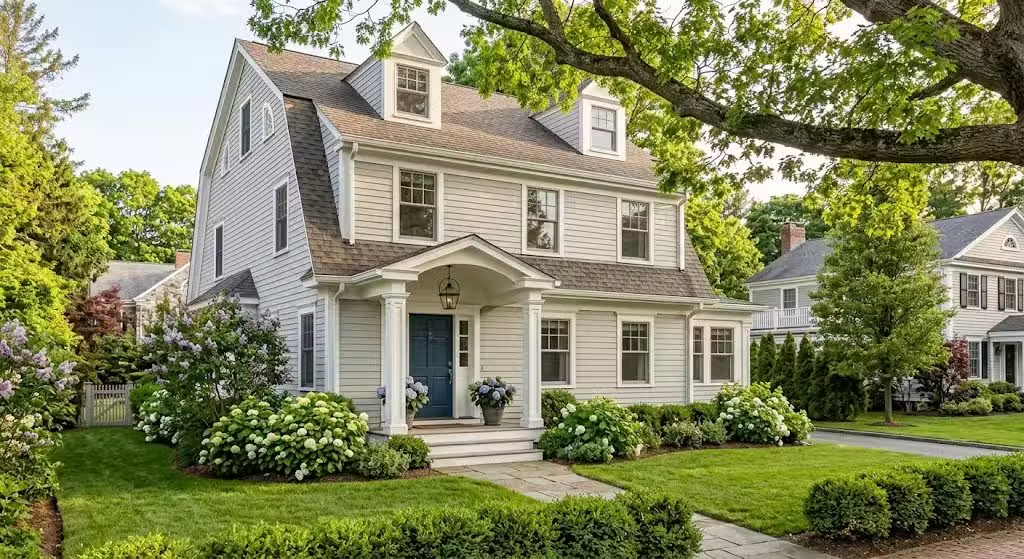
Classic architecture and tree-lined streets in historic Wellesley Hills.
Frequently Asked Questions
Where exactly is Wellesley Hills located in Wellesley, MA?
Wellesley Hills is centered around Washington Street, the Wellesley Hills commuter rail station, and the Linden Square area, along with the surrounding residential streets to the north and south. In practical terms, buyers should think of it as the village-centered section of town anchored by the Hills station, Washington Street amenities, and nearby Linden Square.
(Click map to zoom or interact)
Compared with Dana Hall, Wellesley Hills is less tied to Wellesley Square and more oriented around its own retail and commuter hub. Compared with Wellesley Farms, it feels more connected to daily services, shopping, and major roads.
What is the commute like to Boston and the Mass Pike?
Wellesley Hills offers one of the more flexible commuter setups in town. For rail commuters, the neighborhood is anchored by the Wellesley Hills Station on the Framingham/Worcester Line. For drivers, the area benefits from quick access to Washington Street, Linden Street, Route 9, Interstate 95, and the Massachusetts Turnpike corridor.
Compared with Wellesley Farms, the Hills is generally easier to build a car commute around because of its closer relationship to Route 9 and the Linden Square corridor.
Compared with Dana Hall, it trades some of Wellesley Square’s walkability for easier regional road access.
Which schools serve the Wellesley Hills neighborhood?
Wellesley Hills is served by the Wellesley Public Schools, consistently ranked among the top districts in the state. In the broader Wellesley Hills area, buyers will most often encounter homes tied to Sprague, Schofield, Fiske, and parts of Hunnewell, depending on the exact street and address. In the village core, Linden Street is assigned to Sprague, while lower Washington Street and nearby side streets often fall into Schofield, with parts of Washington Street also assigned to Fiske and Hunnewell as the corridor extends west. Buyers should confirm their specific address using the town’s official Elementary School Districts by Street lookup before relying on any listing description.
Private-school access is also strong. While not located directly within Wellesley Hills, Dana Hall School, Tenacre Country Day School, and St. John School are all nearby and easily reachable from the neighborhood, giving local families convenient access to respected private-school options elsewhere in town.
What recreational amenities are available near Wellesley Hills?
Wellesley Hills residents have access to a wide array of neighborhood-specific and town-sponsored amenities. Locally, Fuller Brook Park and the Brook Path provide a practical corridor for walking, jogging, and biking through central Wellesley and into Wellesley Hills. The neighborhood also benefits from close proximity to Linden Square and the broader Wellesley Hills village center, reinforcing its connected, village-centered feel.
In addition, the Wellesley Recreation Department offers a broad calendar of programs, youth sports, after-school activities, and special events throughout the year.
What are the typical property sizes and home styles in Wellesley Hills?
Wellesley Hills offers a broader architectural mix than many of the town’s more uniform neighborhoods. The area is shaped by its early-20th-century character, with a blend of Colonials, Tudors, Capes, and Garrison-style homes, alongside newer high-end construction.
Lot sizes are also more varied here—generally more spacious than those in Dana Hall, yet more manageable than the larger estates often found in Wellesley Farms. That range, combined with the neighborhood’s hilly topography, gives buyers more flexibility in home style, lot size, and price point than many other parts of Wellesley.
Wellesley Hills vs. Wellesley Farms: Two Distinct Lifestyles in Wellesley
The choice between Wellesley Hills and Wellesley Farms is fairly straightforward: Wellesley Hills offers greater everyday convenience, easier day-to-day driving, and a more connected village-centered lifestyle, while Wellesley Farms is more car-dependent and offers more privacy, more separation between homes, and a quieter natural setting. Buyers who want easier access to shops, services, and major commuting roads may find Wellesley Hills the better fit. Buyers who value a more pastoral, lower-density setting may prefer Wellesley Farms.
To help you evaluate the differences in neighborhood features, the table below compares Wellesley Hills and Wellesley Farms side by side.
| Feature | Wellesley Hills | Wellesley Farms |
|---|---|---|
| Character1 | Established & Convenient | Pastoral & Secluded |
| Sale Price (Median Sold)2 | $1.93M YTD as of Apr. 9, 2026 |
$1.975M Range: $1.88M–$2.07M |
| Architecture3 | Classic Colonials, Tudors & Newer Construction | 1920s Tudors & Shingle Style |
| Lot / Landscape4 | 0.25–1.0 acres | Mixed & Village-Centered | Broader housing mix and lot pattern | 0.4–1.0+ acres | Wooded & Hilly | Deep setbacks; private retreat feel |
| Commute5 | Train access & easier driving | Shortest rail trip to Boston |
- 1Character: Reflects overall neighborhood pattern and day-to-day lifestyle.
- 2Pricing: Wellesley Hills pricing is based on MLSPIN year-to-date market data as of April 9, 2026 (3 homes sold). Wellesley Farms pricing reflects Redfin February 2026 neighborhood housing data (5 homes sold). The range shown for Wellesley Farms is a ±5% presentation band around the reported monthly median sold price.
- 3Architecture: Reflects dominant housing character and common home styles, not a complete architectural inventory.
- 4Lot / Landscape: Reflects typical neighborhood patterns and not every property in the area.
- 5Commute: Reflects relative convenience to commuter rail and regional road access.
Data Source: MLSPIN, Redfin & Team Coyle Analysis 2026.
Ready to Make Your Next Move?
REALTORS®
In a market like Wellesley Hills, the right strategy—and the right agent—make all the difference.
Let’s Talk — no pressure, no timeline
Disclaimer: The information, opinions, estimates, market commentary, neighborhood descriptions, school references, commute information, pricing, inventory data, lot sizes, boundary descriptions, and other content on this page are provided for general informational and educational purposes only and should not be relied upon as legal, tax, accounting, appraisal, investment, mortgage, financing, zoning, permitting, title, insurance, fair housing, construction, or other professional advice. Information is based on sources believed to be reliable, including MLS PIN, public records, third-party portals, and Team Coyle analysis, but accuracy, completeness, timeliness, and current availability are not guaranteed. Market conditions and property information may change without notice, and Team Coyle has no obligation to update or revise this content. Neighborhood names, school assignments, commute times, and boundary descriptions reflect common local, MLS, mapping, and real estate usage and may not correspond to legal, municipal, or exact boundary lines. Users are solely responsible for independently verifying all facts and for consulting the appropriate licensed or qualified professionals before making any decision or taking any action. Team Coyle is not liable for any loss, damage, cost, or consequence arising from reliance on this content.