Expert Forecasts Show Housing Affordability Improving in 2026

Couple standing in front of a home with a rising chart graphic representing improving housing affordability in 2026.

Wondering what to expect from the housing market in 2026? You’re not the only one.

For the past few years, affordability has been the biggest barrier standing between most people and their next move. And a lot of buyers and sellers have been holding their breath waiting for things to get better. The good news? It’s finally happening.

In 2025, affordability was the best it’s been in three years. And experts agree the momentum will keep going in 2026. That outlook is based on their analysis of three key factors shaping the housing market in the year ahead: mortgage rates, inventory, and home prices.

Lower Mortgage Rates Are Already Here

Mortgage rates have already come down from their peak. By some counts, they dropped by almost a full percentage point over the course of the last year. And that’s a big deal, even if it doesn’t sound like it.

But how low will they go? And should you wait for them to come down more? Here’s your answer.

Forecasts suggest rates will stay relatively stable and hover in the low 6% range throughout 2026. That’s especially true when you look at recent mortgage rate forecasts.

Chart showing 30-year fixed mortgage rates declining from 2024 and forecasted to hover in the low 6 percent range through 2026.

Where rates go from here will depend on the broader economy, the job market, and any changes the Federal Reserve makes in monetary policy. The important thing to remember is this: rates are already lower than they were a year ago, which makes a 2026 move more realistic for many people.

  • For buyers: Lower rates reduce monthly payments and increase buying power, helping more people qualify for homes that once felt out of reach.
  • For sellers: Rates in the 6s may be the new normal. If you need to move, it’s still very doable—especially if you’re bringing equity to the table.

Even More Options Are on the Way

In 2025, the number of homes for sale increased by about 15%. As inventory improved, buyers regained something they hadn’t had in years: options, time to evaluate them, and negotiating leverage. That helped restore balance to the housing market, something we’ve been tracking closely as inventory trends across the market continue to evolve.

Inventory growth has also played a major role in slowing price growth, which directly supports improved affordability.

Experts at Realtor.com expect the supply of homes for sale to grow by another 8.9% heading into 2026.

  • For buyers: More inventory means more choice and more room to negotiate.
  • For sellers: Pricing your home correctly will matter more than ever to attract serious buyers.

Home Price Growth Is Slowing to a More Sustainable Pace

With more homes available, there’s less upward pressure on prices. While most experts agree prices will continue to rise nationally, the pace of that growth is expected to be much slower.

On average, forecasts call for about 1.6% price growth in 2026.

Bar chart comparing expert forecasts for home price growth in 2026, showing moderate appreciation across most projections.

That’s reassuring if you’ve seen social media predictions claiming prices are about to crash. The reality of where home prices are heading is far less dramatic.

Some markets will outperform the national average. Others may see flat or slightly declining prices. That’s why working with a local real estate professional matters.

  • For buyers: Slower growth means fewer surprises and more predictable budgeting.
  • For sellers: A more balanced market helps protect your equity without overheating prices.

More Homes Will Sell in 2026

All of these trends—stabilizing rates, increased inventory, and moderated price growth—point toward improved affordability. And that’s why experts expect more homes to sell in 2026 than in the last two years.

Graph illustrating total home sales increasing in 2026 compared to 2024 and 2025, based on expert housing market forecasts.

As Mischa Fisher, Chief Economist at Zillow, explains:

“Buyers are benefiting from more inventory and improved affordability, while sellers are seeing price stability and more consistent demand. Each group should have a bit more breathing room in 2026.”

The bottom line? More people will finally be able to make a move this year. The market is opening a window of opportunity many haven’t had in a while—and why many homeowners are choosing to sell in 2026.

Bottom Line

Affordability won’t change overnight. But with several key trends working together, it should continue to improve steadily throughout 2026.

That means a market with more balance, more predictability, and more breathing room for both buyers and sellers.

Matt & Ying Coyle, REALTORS®
Team Coyle at Compass

Your 2026 Real Estate Action Plan Starts Here

Expert Guidance for Wellesley, Natick, and Greater Boston

Curated Listings

By Team Coyle at Compass

$6,995,000

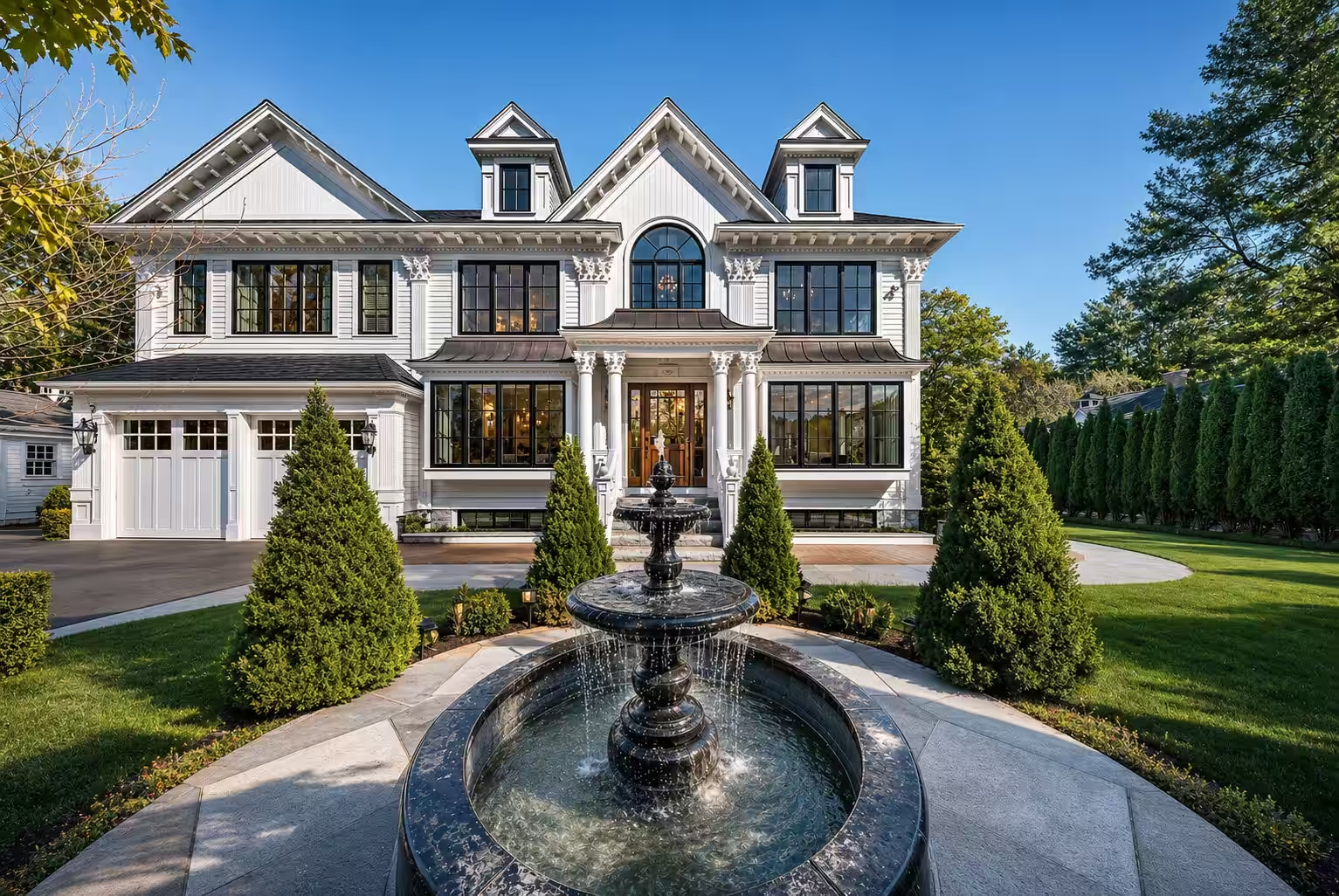
121 Livingston Rd

121 Livingston Rd, Wellesley, MA 02482

6 Beds  |  10 Baths  |  10,090 Sq Ft

$2,590,000

1 Clock Tower Drive

1 Clock Tower Dr, Wellesley, MA 02481

5 Beds | 5 Baths | 5,261 Sq Ft

Disclaimer: The information and opinions in this article are provided for general educational purposes only and are not financial, investment, or mortgage advice. Team Coyle | Compass does not guarantee the accuracy or completeness of the information provided. Market conditions can change without notice. Always conduct your own research and consult qualified professionals (e.g., licensed lenders, financial advisors) before making financing or investment decisions. Team Coyle | Compass is not liable for any loss or damage arising from reliance on this content.
Scroll to Top

Schedule a Consultation

Matt Coyle, REALTOR®

Methodology

TownRatings™ is a proprietary model developed by Team Coyle to provide homebuyers and sellers with a relative rating (assessment) of a town’s key characteristics, benchmarked against other Greater Boston towns. Ratings are based on publicly available data and Team Coyle’s on-the-ground expertise and are intended as a general guide only. Please consult a licensed real estate professional before making any real estate decisions. Ratings are current as of October 4, 2025.

RATING CATEGORIES

  • Quality of Schools: Based on Massachusetts Department of Elementary and Secondary Education (DESE) 2024 data, emphasizing Grade 10 MCAS English Language Arts and Mathematics proficiency rates and 4-year high school graduation rates. Together, these measures provide a snapshot of academic achievement and long-term outcomes.
    Scale: Above Average · Average · Below Average
  • Commute to Boston: Assesses commuting ease using travel time, distance, and in-town transit access. For towns with MBTA rail or subway service, commute times are measured to the line’s natural Boston endpoint (e.g., North Station, South Station, or Back Bay). For towns without in-town service, commute times are measured by car to Back Bay as the default reference point.
    Scale: Easy · Moderate · Challenging
  • Shopping & Dining: Reflects the density and variety of retail and restaurant options within a town or in adjacent hubs.
    Scale: Excellent · Good · Limited
  • Lifestyle: A general description a town's overall character (e.g., Upscale, Rural, Historic, Suburban, Urban/Vibrant).
  • Est. Annual Tax per $1M: The town’s residential property tax rate applied to $1,000,000 of value (as of the report date) for easy comparison.

HOW RATINGS ARE DERIVED

Ratings are determined using a blend of publicly reported data (e.g., DESE reports, MBTA schedules, municipal tax rates, business directories), mapping and transportation tools, and qualitative insights from Team Coyle agents active in these markets.

LIMITATIONS & DISCLAIMERS

  • Informational only; subject to change without notice.
  • No duty to update: Team Coyle and its agents are not obligated to refresh or revise ratings.
  • No warranties: Information is provided “as is” without warranties of any kind.
  • No liability: Team Coyle, its agents, and Compass are not liable for any losses, damages, or costs arising from use or reliance.
  • Not advice: not legal, tax, financial, educational, or transportation advice. Consult a licensed real estate professional/agent and other appropriate professionals.
  • Verify independently: Commute times vary (route/time/weather) — check MBTA schedules and test commutes. School offerings and performance change — confirm with districts and the MA Dept. of Elementary & Secondary Education. Amenities evolve — verify locally.
  • Third-party content not endorsed; accuracy not guaranteed. Trademarks belong to their owners.
  • Broker disclosure: Compass is a licensed real estate broker and abides by Equal Housing Opportunity laws.
  • Fair housing: Nothing here should be used to encourage or discourage housing decisions based on protected characteristics.