Real Estate News

The 20% Down Payment Myth, Debunked

Fan of US $100 bills partially out of a white envelope on a white background.

Saving up to buy a home can feel a little intimidating, especially right now. And for many first-time buyers, the idea that you have to put 20% down can feel like a major roadblock.

But that’s actually a common misconception. Here’s the truth.

Do You Really Have To Put 20% Down When You Buy a Home?

Unless your specific loan type or lender requires it, odds are you won’t have to put 20% down. There are loan options out there designed to help first-time buyers like you get in the door with a much smaller down payment.

For example, FHA loans offer down payments as low as 3.5%, while VA and USDA loans have no down payment requirements for qualified applicants, like Veterans. So, while putting down more money does have its benefits, it’s not essential. As The Mortgage Reports says:

“. . . many homebuyers are able to secure a home with as little as 3% or even no down payment at all . . . the 20 percent down rule is really a myth.

According to the National Association of Realtors (NAR), the median down payment is a lot lower for first-time homebuyers at just 9% (see chart below):
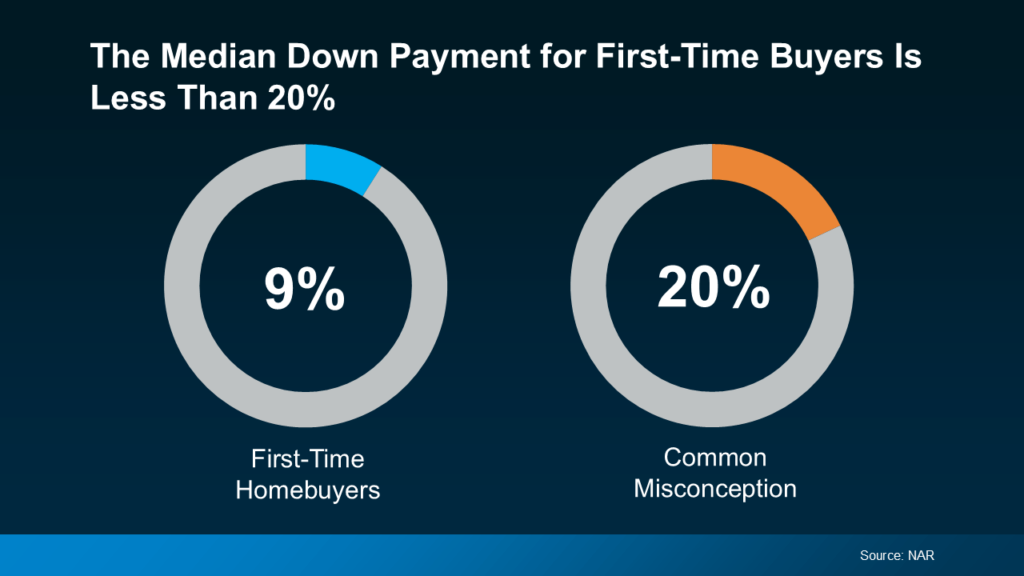
Comparison of down payment percentages between first-time and typical homebuyers.

The takeaway? You may not need to save as much as you originally thought.  

And the best part is, there are also a lot of programs out there designed to give your down payment savings a boost. And chances are, you’re not even aware they’re an option.

Why You Should Look into Down Payment Assistance Programs

Believe it or not, almost 80% of first-time homebuyers qualify for down payment assistance (DPA), but only 13% actually use it (see chart below):
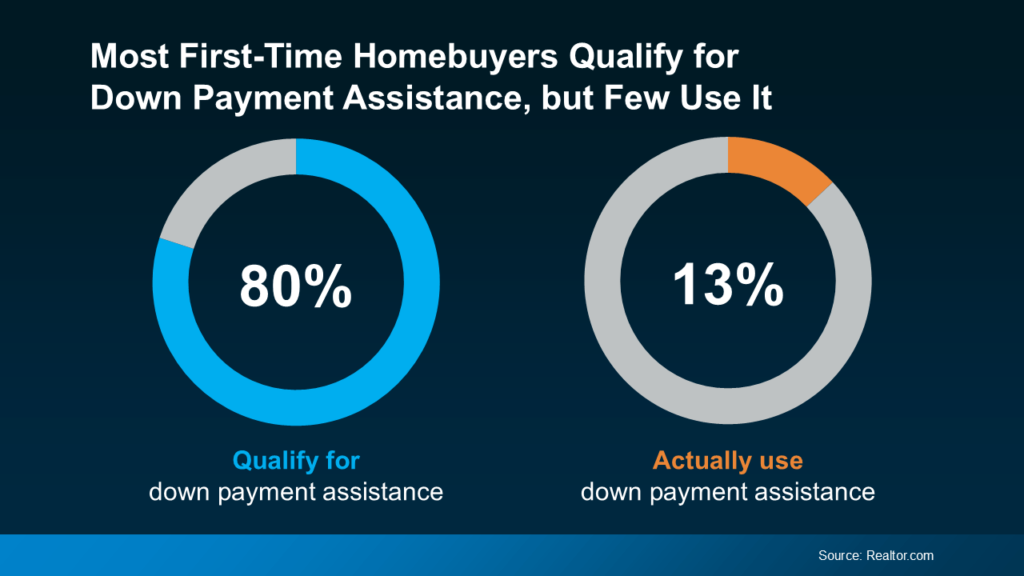
80% qualify for assistance, only 13% use it for down payment.

That’s a lot of missed opportunity. These programs aren’t small-scale help, either. Some offer thousands of dollars that can go directly toward your down payment. As Rob Chrane, Founder and CEO of Down Payment Resourceshares:

Our data shows the average DPA benefit is roughly $17,000. That can be a nice jump-start for saving for a down payment and other costs of homeownership.”

Imagine how much further your homebuying savings would go if you were able to qualify for $17,000 worth of help. In some cases, you may even be able to stack multiple programs at once, giving what you’ve saved an even bigger lift. These are the type of benefits you don’t want to leave on the table. 

Bottom line

On average, over 11,000 homes sell every day, and yours could be one of them. In the time it took you to read this, another 8 homes sold. When you’re ready to take the next step, let’s connect so you have an agent to create that perfect strategy.

 
Scroll to Top

Methodology

TownRatings™ is a proprietary model developed by Team Coyle to provide homebuyers and sellers with a relative rating (assessment) of a town’s key characteristics, benchmarked against other Greater Boston towns. Ratings are based on publicly available data and Team Coyle’s on-the-ground expertise and are intended as a general guide only. Please consult a licensed real estate professional before making any real estate decisions. Ratings are current as of October 4, 2025.

RATING CATEGORIES

  • Quality of Schools: Based on Massachusetts Department of Elementary and Secondary Education (DESE) 2024 data, emphasizing Grade 10 MCAS English Language Arts and Mathematics proficiency rates and 4-year high school graduation rates. Together, these measures provide a snapshot of academic achievement and long-term outcomes.
    Scale: Above Average · Average · Below Average
  • Commute to Boston: Assesses commuting ease using travel time, distance, and in-town transit access. For towns with MBTA rail or subway service, commute times are measured to the line’s natural Boston endpoint (e.g., North Station, South Station, or Back Bay). For towns without in-town service, commute times are measured by car to Back Bay as the default reference point.
    Scale: Easy · Moderate · Challenging
  • Shopping & Dining: Reflects the density and variety of retail and restaurant options within a town or in adjacent hubs.
    Scale: Excellent · Good · Limited
  • Lifestyle: A general description a town's overall character (e.g., Upscale, Rural, Historic, Suburban, Urban/Vibrant).
  • Est. Annual Tax per $1M: The town’s residential property tax rate applied to $1,000,000 of value (as of the report date) for easy comparison.

HOW RATINGS ARE DERIVED

Ratings are determined using a blend of publicly reported data (e.g., DESE reports, MBTA schedules, municipal tax rates, business directories), mapping and transportation tools, and qualitative insights from Team Coyle agents active in these markets.

LIMITATIONS & DISCLAIMERS

  • Informational only; subject to change without notice.
  • No duty to update: Team Coyle and its agents are not obligated to refresh or revise ratings.
  • No warranties: Information is provided “as is” without warranties of any kind.
  • No liability: Team Coyle, its agents, and Compass are not liable for any losses, damages, or costs arising from use or reliance.
  • Not advice: not legal, tax, financial, educational, or transportation advice. Consult a licensed real estate professional/agent and other appropriate professionals.
  • Verify independently: Commute times vary (route/time/weather) — check MBTA schedules and test commutes. School offerings and performance change — confirm with districts and the MA Dept. of Elementary & Secondary Education. Amenities evolve — verify locally.
  • Third-party content not endorsed; accuracy not guaranteed. Trademarks belong to their owners.
  • Broker disclosure: Compass is a licensed real estate broker and abides by Equal Housing Opportunity laws.
  • Fair housing: Nothing here should be used to encourage or discourage housing decisions based on protected characteristics.

Get in Touch

Matt Coyle, REALTOR®
Address
161 Linden St, Suite 102
Wellesley, MA 02482